
ON THE MORNING of 2 August, Artyom Kirpichenok landed at Ben Gurion airport on a flight from Yerevan. At 10:41 he messaged the people expecting him to say the plane was down. About five minutes later his activity on social media stopped. He never reached the flat in Ashkelon where he meant to stay. He never appeared at the event he had flown in to attend. His return ticket, bought for 8 August, went unused. From the moment of that message, no one who was waiting for him has been able to reach him, and no one who is looking for him can say where he is.¹
He is a fifty-one-year-old historian who holds citizenship of two countries, and it was the passport of one of them — Israel, the country he had lived in for fifteen years, studied in, served in — that he was carrying when he walked off the plane and out of view.
That is the whole of what is known. Everything after it is silence.
The Silence
Start with the state, because the state is the one body that could end the question with a sentence. It has not. There has been no charge. There has been no hearing anyone can point to. There has been no statement confirming that Kirpichenok is held, or was ever held, or is free to go. What is certain is that he landed, and that he never came out of the airport. Russia’s ambassador to Israel, Anatoly Viktorov, said on 5 August that his embassy had taken note of the reports and had sent a request about Kirpichenok to the relevant Israeli authorities. He did not say the request had been answered.² Yet Kirpichenok remains missing, eleven days after the plane landed, and the country that holds his passport has said nothing about the man carrying it.
Around that silence sits a second one. This is a story about a citizen of a Western-aligned democracy who vanished at an international airport, and it has not been reported by a single wire service. Not the Associated Press, not Agence France-Presse, not Reuters. It has not appeared in the Guardian, the BBC, the New York Times, the Washington Post. The entire visible record of the case runs through a handful of Israeli outlets treating it as an unexplained curiosity, Russian state and state-aligned media, and a small circle of activists. A man disappears inside a functioning state and the machinery of Western journalism, which exists precisely to notice such things, has not turned toward it.³
And around that sits a third silence, the sharpest of the three. The outlets that report on exactly this — Israeli detention of critics, the treatment of people who cross the state’s lines — have not run it either. Middle East Eye, Mondoweiss, the Electronic Intifada: these are not general-assignment desks that missed a foreign story. This is their subject. When Israel held the journalist Majd Kayyal in 2014, they covered it. They know this beat. On Kirpichenok, so far, they have said nothing.
There is an innocent explanation for the second and third silences. The only people asserting that Kirpichenok has been detained are Russian state media and a network of activists aligned with them. No Israeli official has confirmed it. No court record shows it. His own lawyer has not spoken. A careful editor, handed a disappearance sourced entirely to those quarters, waits — waits for a second, independent confirmation before putting the outlet’s name behind the claim. That instinct is not cowardice. In the ordinary run of things it is exactly right.
But this is not the ordinary run of things, and the waiting has a flaw that this case exposes. The confirmation the editors are waiting for can only come from one place: the same state apparatus holding him. If he is inside a security investigation under a gag order, there will be no confirmation to wait for — not next week, not next month, not until the state decides. The event that finally breaks the silence may not be a charge sheet or a court date. It may be the news that he has been released after a fortnight with nothing to show for it, or the news that he has not been released at all. By the time the story is confirmed enough to be safe, it may no longer be a story about a man who can still be helped. It may be a story about one who cannot. The moment to apply pressure to a state that has made a person disappear is while the pressure can still change what happens to him — not after the outcome is fixed and the reporting is finally, uselessly, certain.
So the silence is not the absence of a story. The silence is the story. A man went through his own country’s airport and vanished, and every party that might account for him — the state that should explain, the press that should ask, the advocates who should shout — has, for its own reasons, said nothing. Which leaves the simplest question of all. Where is he?
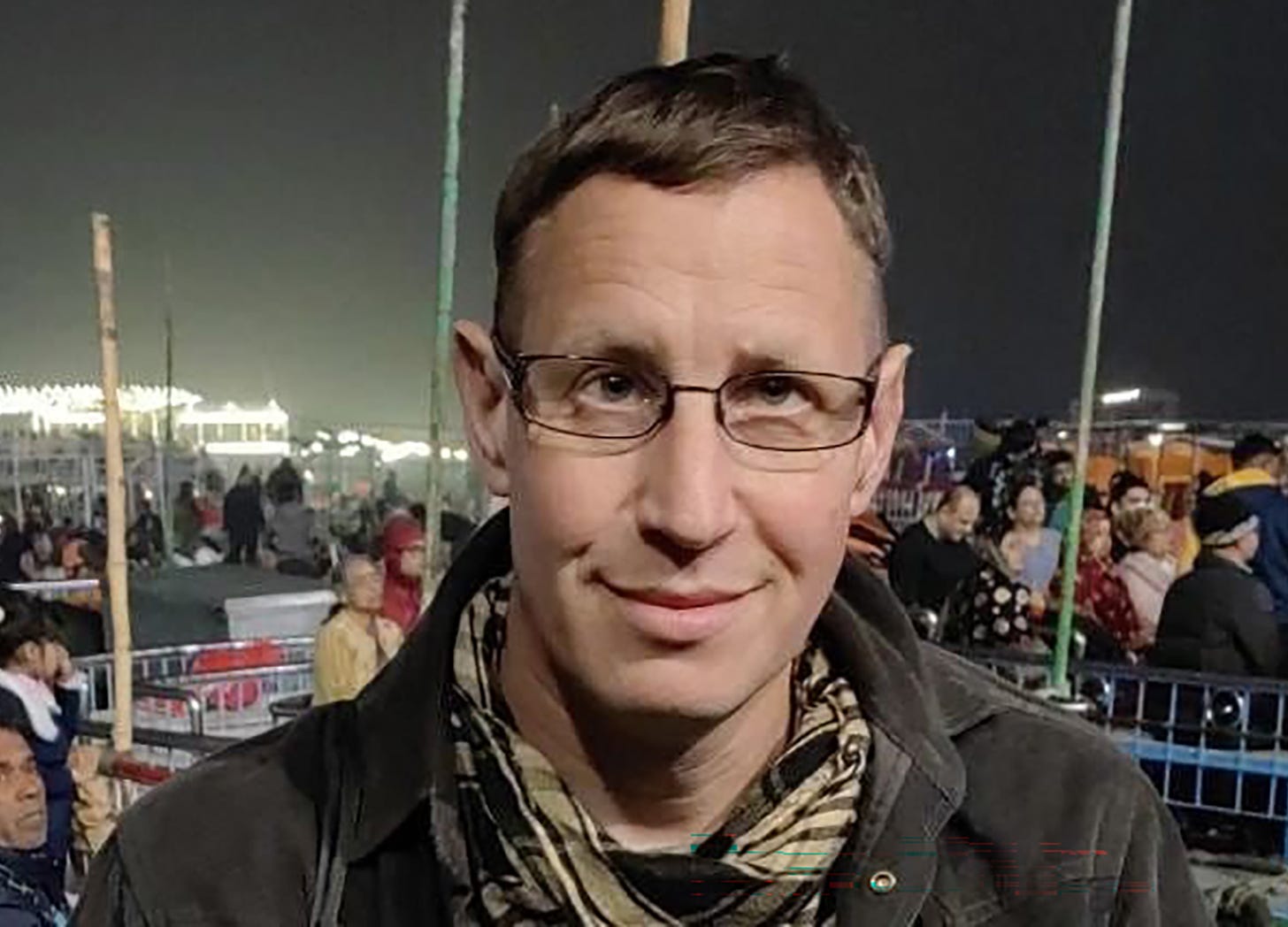
The Man
Artyom Kirpichenok is a historian. He was born in Leningrad in 1975, emigrated to Israel with his family in the early 1990s, studied at the Hebrew University of Jerusalem, served in the Israeli army, and lived in the country for some fifteen years before returning to Russia, where he has worked since as a writer and publicist. He holds a doctorate. He has written books — a people’s history of Israel, a book on the 1956 Hungarian uprising, a study of Serbian settlement in eighteenth-century Ukraine. He is, by every account including those of his critics, a serious and productive scholar.
He is also, and without apology, an enemy of the Israeli state’s account of itself. His subject for years has been the case against Zionism — not the policies of one government or another, but the foundations. His people’s history of Israel is described, in its own catalogue, as a collection continuing the long tradition of Jewish criticism of the state — the insistence that to oppose Israel’s conduct is not to oppose Jews. His later books press the argument toward its sharpest form: that the Israeli project is a colonial one, and that it is heading, on its present course, toward catastrophe. This is not the work of a pamphleteer. It is the work of a trained historian who has spent a career assembling the counter-record — the version of events the state would prefer stayed in the margins — and presenting it with the apparatus of scholarship: sources, footnotes, the weight of a doctorate behind it.
He took the same argument into the present. In recent months, writing for the Russian-language service of Turkey’s state broadcaster, he compared Israel’s treatment of its Arab citizens to apartheid, examined Israel’s fear of Turkey as a rising power, and gave one essay on the country’s self-image after October 7 the title “The whole world hates us, and we’re proud of it.”⁴ This is not a man who criticised at the margins. He went at the centre, in public, in print, repeatedly.
And he went further than words on a page. Twice — in 2018, and again in 2022 — Kirpichenok travelled to Iran, a country almost no Israeli citizen sets foot in, and wrote about it. Of the first trip he was disarmingly direct about the appeal: “Being an Israeli citizen, it was very interesting to me to see where our bombs would fall.”⁵ A person can read that as gallows humour or as something colder. Either way, it was an Israeli passport-holder recording, in public, a visit to the state’s declared enemy and musing on the targets.
His politics are genuinely divisive, and not only to Israelis. On the largest question dividing the world he moves in, Kirpichenok has come down on the side of Moscow. Haaretz places him in a small faction of Russian communists who support the invasion of Ukraine, and his published commentary since 2022 has largely tracked the Russian government’s framing of that war.⁶ He has criticised the emigration of Russia’s anti-war dissidents. His defenders abroad are drawn from a corner of the Western left that has its own habit of measuring states by their alignment rather than their conduct — quick to condemn some governments for jailing writers and quiet about others.
This matters, and not as a disclaimer. His politics change nothing about the question his disappearance raises. A person’s views are not a licence for the state to make him vanish, and the more divisive those views, the more honestly that test is put. Whether you share his politics or find them objectionable, the test is the same.
Why Now
There is a question that sits underneath the first one. Not only where he is, but why a man like this, at a moment like this.
For most of his career Kirpichenok was, in the practical sense, harmless. He wrote books that sold in the low thousands. He posted essays to a Russian-language readership that has no vote in Israel and no leverage over it. He held views that a great many people find objectionable, and he held them at a distance of several thousand miles. A state does not, in the ordinary course of things, reach across a continent to lay hands on a fifty-one-year-old academic because he thinks the wrong things about its founding. There are millions who think the wrong things. It cannot detain them all, and it does not try.
What a historian produces, though, is not opinion. It is the other account — the documented, footnoted, sourced version of events that competes with the one a state tells about itself. That is a different kind of object from a slogan. A slogan can be shouted down. An account has to be answered, and the more credentialled the person making it, the harder it is to wave away. Kirpichenok’s entire body of work is the construction of that competing account: the argument that the Israeli state is a colonial project, made not as a chant but as history, by a man with a doctorate and a shelf of books to lend it weight.
In a settled time, that work is an irritant and no more. But this is not a settled time. Israel is fighting on several fronts at once, and it is losing something on all of them that it cannot replace by force — the argument. At the International Court of Justice, it stands as the respondent in a genocide case brought by South Africa; the court has issued a series of binding provisional orders requiring it to prevent genocidal acts in Gaza and to allow humanitarian aid, orders it has been widely found not to have complied with. The International Criminal Court has issued arrest warrants for its prime minister, Benjamin Netanyahu, and its former defence minister, Yoav Gallant, on charges including the war crime of starvation and crimes against humanity — warrants that make them liable to arrest in any of the more than a hundred states party to the court. And in September 2025 a United Nations commission of inquiry, chaired by the former war-crimes judge Navi Pillay, concluded that Israel is committing genocide against the Palestinians of Gaza — the word the state has spent two years insisting does not apply, now written into the record of a UN body.⁷ Each of these is a defeat not on the battlefield but in the domain that outlasts the fighting: the record of what happened, and who is judged to have done it. The ground of the fight has shifted from the terrain where Israel is dominant to the one where it is not — to the contest over whose account of the last two years the world will finally believe.
A state fighting for its account of itself has a particular reason to fear the people who produce the rival account. The most likely explanation for why Kirpichenok was worth reaching for is not that he held hostile views, but that he wrote a rigorous, sourced, hard-to-dismiss history the Israeli government found objectionable, and that he did so at the moment the state could least afford the competition. None of this is proven. What happened inside the airport is known to one party, and that party is silent. But of the explanations available for why a man like this vanished at a moment like this, it is the one that fits what is known — and the one the state could end in a sentence, if it were false. The disappearance of a critic is an act of suppression. The disappearance of a historian, in the middle of a war over the historical record, is something more precise. It is the removal of a witness.
The Doors
A person who lands at an airport and is not seen again has not evaporated. He passed into the controlled space of a state border and did not pass out of it, and the state that runs that border will not say what became of him. That settles more than it seems to. He did not vanish; he was made to vanish, inside the one place on earth where nothing moves unrecorded and no one is taken without authority. A man does not slip through Ben Gurion unseen. If Kirpichenok is gone, the state that controls every step of that ground is the party that made him gone. The only question the outside world cannot yet answer is which hand of the state is holding him — and the possibilities narrow to three.
The first is that he is being held by the security service. This is the reading the available claim points to: Darya Mitina, a Russian former parliamentarian, wrote on 5 August that Kirpichenok was in the custody of the Shin Bet, Israel’s internal security agency.⁸ Her claim is the origin of nearly everything said about his whereabouts since, and it should be weighed for what it is — an assertion by a politically aligned figure, not confirmed by Israel, not corroborated by his lawyer, not supported by any court record. It is thin. But it does not stand alone, and it is not the reason the security-service door ranks first. That reason is the shape of the disappearance itself. A man detained for questioning at a border and released a few hours later resurfaces. A man held in the ordinary criminal system gets a hearing, and a hearing leaves a trace. A total blackout — no contact, no location, no acknowledgement, sustained for eleven days — is the signature of a security hold, because a security hold is the one kind of detention the law permits to be conducted in exactly this way: incommunicado, unacknowledged, and sealed from the press. The disappearance looks like a Shin Bet case because a Shin Bet case is what a disappearance of this shape looks like.
The second possibility is an ordinary criminal detention under the law that makes his two Iran trips a crime. An Israeli citizen who travels to an enemy state without permission commits an offence, and Iran is on the list. If that is what happened, Kirpichenok is somewhere in the regular remand system awaiting a charge. But this door fits less well, because the regular system is not silent. It produces dockets, hearing dates, the ordinary paper trail of criminal process — and none has appeared. Either that paper is being suppressed, which points back toward the security apparatus and its gag orders, or he is not in that system at all.
The third possibility is that he was refused entry and is being held for deportation. One early Russian account raised it. It is the weakest fit — a deportation is an administrative act that neither the deportee’s family nor a foreign embassy is usually kept in the dark about for eleven days — but it cannot be ruled out from the outside, and it belongs on the list precisely so that the state can be asked to rule it out.
Three doors, then, and behind each of them the same fact: the key is held by one party. The Israeli state knows which door Kirpichenok is behind. It knows because if he is in a security cell, its agency put him there; if he is in remand, its courts are processing him; if he is awaiting deportation, its border authority is holding him; and if he is behind none of the three — if he walked out of the airport a free man and simply vanished into the country — then it is the one party with the machinery to establish that, and the one party that has chosen not to. Every branch of the possibility ends in the same place. The state can say where he is. It has not.
How It’s Done — and Done Lawfully
The most disturbing thing about a disappearance of this kind is not that it breaks the law. It is that it may not have to.
Israel has, on its books, the machinery to make exactly this happen and to keep it hidden. Three instruments, each ordinary, each lawful, together sufficient.
The first is the offence. Under the Prevention of Infiltration Law, an Israeli citizen who knowingly and unlawfully leaves the country for an enemy state commits a crime punishable by up to four years in prison. Iran was added to the list of enemy states by amendment in 2007.⁹ This is not a dormant provision. In a case decided in the Tel Aviv District Court, an Israeli citizen who had travelled to Iran to deal with property he owned there — after being warned by security officials not to go — had his sentence increased on appeal, the court holding that the security of the state takes precedence over a citizen’s freedom of movement, and that the gravity of the offence lies in the unlawful departure itself, whatever the traveller’s reasons.¹⁰ Kirpichenok travelled to Iran not once but twice, and wrote about it under his own name. If the state wished to build a case, the material is already public, supplied by the man himself.
The second instrument is the hold. Israel’s security service may detain a person suspected of a security offence and question him without access to a lawyer, for days at a stretch, without producing him in open court and without confirming the detention to anyone outside. The denial of counsel is not a loophole; it is a provision, available in security cases and used in them.
The third is the silence. An Israeli court may impose a gag order — a tzav issur pirsum, a prohibition on publication — that bars the country’s media from reporting a case at all. Such orders are not rare or exotic; they are a routine instrument of the security courts, granted on the state’s application, often for weeks at a time, and renewable. In its strongest form such an order forbids reporting even the existence of the order, so that the public cannot know there is anything it is not being told. The press does not defy these orders, because the penalty for defying them is real, and so the silence they produce is total within the country’s borders. This is the instrument that closes the circuit. The offence gives the state a reason to detain. The security hold lets it detain in silence. The gag order ensures the silence holds. A citizen can be taken, questioned incommunicado, and processed through a court, and the first the public may learn of it is when the state chooses to lift the veil — or when someone outside its jurisdiction, beyond the reach of the order, says something.
This is not hypothetical. In April 2014, a Palestinian citizen of Israel named Majd Kayyal, a young journalist who worked as a web editor for the legal centre Adalah, travelled to Beirut to attend a conference marking the fortieth anniversary of a Lebanese newspaper. Lebanon, like Iran, is an enemy state. Kayyal made no secret of the trip; he wrote about it on his own social media before he went. On his return he was arrested at the border by the Shin Bet, held incommunicado in a windowless cell with the lights kept on around the clock, and denied access to a lawyer for five days. His interrogators questioned him about contact with a foreign organisation. A gag order kept the entire affair out of the Israeli press, and while it held, his family’s home was searched. The order was lifted only after Adalah and a group of journalists petitioned the court to remove it — and only then did the country learn that a journalist had been sitting in a security cell for the better part of a week, on suspicion of a crime that amounted to attending a conference. He was released to house arrest, barred for a time from leaving the country or contacting anyone outside it, and in the end the charges were dropped.¹¹ He had gone to a conference, and written about it, and that had been enough.
Change the country from Lebanon to Iran, the conference-goer to a historian, and the year to now, and the Kayyal case is a description of what the machinery does. It is offered here not as proof of what happened to Kirpichenok — no one outside the state can offer that — but as evidence that the thing being described is real, that it has been done before, to a person of much the same profile, for much the same reason, and that when it was done, it looked exactly like this: a man crossing a border, a silence, and a public that knew nothing until someone made it impossible not to.
What Is Most Likely True — and What Would Prove It Wrong
Here is where the evidence stands, and what would overturn it.
On the evidence available — the manner of the disappearance, the profile of the man, the moment he was taken from, and the existence of a legal machinery built to produce precisely this outcome — the most probable explanation is that Artyom Kirpichenok is being held by the Israeli security service in connection with a security investigation, most likely one that touches his travel to Iran, his writing, or both, and that the silence around him is the ordinary working of a gag order rather than the absence of anything to report. That is a probability, not a certainty. It is where the evidence points, held to the standard the evidence allows.
What would overturn it is short and specific. If the Israeli authorities confirm that Kirpichenok was never in their custody, and that he left the airport and travelled onward, the reading is wrong and should be dropped. If he surfaces — released, deported, or simply reappearing — with an account that contradicts this one, it should be dropped. If a document emerges showing he is held in the ordinary criminal system with a hearing on the calendar, the specific claim about the security service is wrong, though the larger point about the silence would stand. Any of these would settle it. Every one of them requires the state, or Kirpichenok himself, to speak — and at the moment neither can, or will.
That is the trap. The claim made here is falsifiable in principle and unfalsifiable in practice, and it is unfalsifiable in practice for a single reason: the one body that could refute it in a sentence has chosen silence instead. A state that could end a damaging inference by producing a man, or a charge, or a simple statement of where he is, and declines to do so, invites the inference it declines to rebut. It cannot complain of being misread when it has made itself the sole author of the confusion.
And this is a live case. The veil may lift — Kirpichenok charged, or freed, or produced, and the question of where he is answered at last. That answer, when it comes, will be the measure of everything here. But the machinery does not care about the calendar, and the argument does not depend on the outcome. Whether he walks out tomorrow or vanishes for a year, the fact that a man could be made to disappear this completely, this lawfully, and this quietly, is the thing worth understanding — because it did not begin with him and it will not end with him.
The Convergence
The silence is where this began, and it is where the responsibility sits.
The state’s silence is a choice. It could produce Kirpichenok, or a charge, or a single sentence saying where he is, and it has chosen instead to say nothing, for eleven days, to a family, a foreign embassy, and a watching handful of people who noticed. The press’s silence is a caution — reasonable in the ordinary case, and the wrong instinct in this one, because the confirmation the editors are waiting for can only come from the state that is producing the silence, and it may never come, or come too late to matter. And the third silence, the one from the outlets that have made this exact subject their life’s work, is the one most easily broken. They do not need to declare Kirpichenok a martyr. They do not need to be certain. They need only to ask the question loudly enough that the state has to choose between answering it and being seen to refuse — and that question is worth asking now, while the asking can still change what happens to him, rather than after, when all that is left is to mark what did.
None of this depends on whether you share Kirpichenok’s politics. It depends on nothing about him except that he is a person, and that a state has made him disappear. A principle that protects only the people we admire is not a principle. It is a preference, and a preference offers no protection at all to the next person taken, who may be someone we admire, or may be us.
And there is the harder question, the one the silence forces and cannot answer. Look at what converges here. A historian whose work is the rival account of the Israeli state. A state losing the argument about itself on every front that matters — at the world court, at the criminal court, at the United Nations, where the word it has denied for two years was finally written down. A body of law that lets the state arrest a citizen for travelling to an enemy state, hold him in secret, and forbid anyone from reporting it. And a disappearance that fits the machinery as a key fits a lock. No one of those facts proves intent. Together they raise a question the state’s silence does nothing to dispel and everything to sharpen: what is a government that behaves this way trying to control?
The evidence does not permit an answer. It permits a supposition, and it is this. A state that is losing the war over its own story does not fear the man who shouts. It fears the man who documents. It reaches, when it reaches, for the people who write the version it cannot afford the world to believe — and it reaches for them at the moment that version is winning. Kirpichenok wrote that version. He was taken at that moment. What Israel is trying to control is not one historian. It is the account. And the surest sign that the account is worth controlling is the length a state will go to make its author disappear.
Where is Artyom Kirpichenok? The state knows. Everyone else is still waiting for it to say.
Working notes and primary sources on Telegram.
If this resonated with you, consider sharing it — that’s how the fire spreads.
Banner image: Artyom Kirpichenok, from his own social media, used in accordance with fair-dealing provisions for news reporting.
James S. Coates writes about geopolitics, international law, and the decline of civilisational accountability. His books include A Signal Through Time, The Threshold, The Road to Khurasan, the memoir God and Country (published under pen name Will Prentiss) and his forthcoming Neither Gods Nor Monsters. He publishes regularly on Fireline Press and The Signal Dispatch, and his academic work appears on PhilPapers. He lives in the UK, with his family and dog who has no interest in any of this.
© 2026 James S. Coates All Rights Reserved. Fireline Press · fireline.press
Endnotes
¹ Details of the arrival and disappearance — Yerevan flight, the 10:41 message, contact ceasing, the unused 8 August return ticket — from NEWSru.co.il, “Стало известно о задержании в ‘Бен-Гурионе’ публициста Артема Кирпиченка,” 5 August 2026.
² Ambassador Anatoly Viktorov’s statement: TASS, “Diplomats monitor situation around detained Russian orientalist — ambassador,” 5 August 2026. The embassy noted a “presumed” detention on 2 August and said it had submitted a request to the relevant Israeli authorities; it did not report a reply.
³ The recent TRT Russian articles — the apartheid comparison, the Turkey essay, and “The whole world hates us, and we’re proud of it” — as reported in Haaretz, “Russian-Israeli Historian Disappeared After Landing in Israel, Russian Reports Say,” 10 August 2026.
⁴ The 2018 Iran travelogue quotation: Times of Israel, “Russian-Israeli historian missing after landing at Ben Gurion last week,” 10 August 2026, which also records the second (2022) trip.
⁵ Ukraine alignment: Haaretz, 10 August 2026 (as above), placing him in a small Russian communist faction supportive of the invasion.
⁶ International-law findings: ICJ, provisional measures orders in South Africa v. Israel (26 January, 28 March, 24 May 2024); ICC Pre-Trial Chamber I, arrest warrants for Benjamin Netanyahu and Yoav Gallant, 21 November 2024; UN Independent International Commission of Inquiry on the Occupied Palestinian Territory (chair Navi Pillay), report of 16 September 2025 finding Israel responsible for genocide in Gaza on a “reasonable grounds to conclude” standard.
⁷ Darya Mitina’s claim: Jerusalem Post, “Russia ‘monitoring’ as historian critical of Zionism vanishes upon landing in Israel,” 12 August 2026, quoting her Telegram statement (reported via Izvestia) that Kirpichenok is held by the Shin Bet.
⁸ Prevention of Infiltration (Offences and Jurisdiction) Law, 5714–1954, §2A (יציאה שלא כדין), four-year maximum; Iran added by the 2007 amendment (annotation תש”ך, תשס”ז). Text: Hebrew Wikisource and Nevo legal database.
⁹ State of Israel v. Mizrahi, District Court appeal עפ”ג 25495-04-14 (sentence increased on appeal for unlawful exit to Iran; “the security of the state prevails over its citizens’ freedom of movement”).
¹⁰ The Majd Kayyal case, April 2014: Al Jazeera, “Israel frees jailed Palestinian journalist,” 18 April 2014; Adalah, “Gag order lifted on case of arrest of journalist Majd Kayyal,” 16–17 April 2014 (five days without counsel; charges not pursued).
¹¹ Absence of wire-service and mainstream Western coverage, and of coverage by the specialist Middle East and Palestine press (Middle East Eye, Mondoweiss, Electronic Intifada): author’s review of available reporting as of 13 August 2026.